
Next.js for business websites and stores: what it does well and where it costs you
Abdul Wahed Nur · · 1 min read
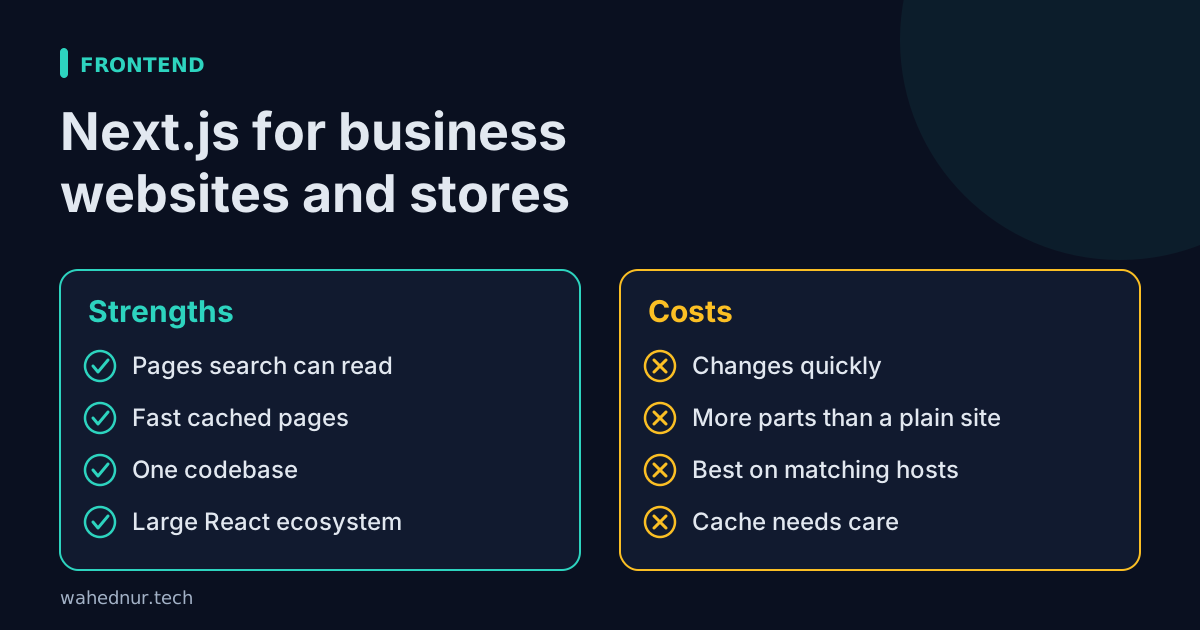
In short: Fast, search-friendly pages with one codebase. It changes quickly and needs care with caching.
Next.js is a framework built on React. It renders pages on the server, so a visitor, and a search engine, receives real content instead of an empty page that fills in later.
What it is good at
- Search-friendly pages. Product pages, blog posts and service pages arrive as finished HTML, with titles, descriptions and structured data in place.
- Speed. Pages can be prepared ahead and cached, then refreshed when content changes. This site refreshes a blog or product page after an edit instead of rebuilding everything.
- One codebase for public pages and signed-in areas. The public site and the client area can live together.
- React. A huge ecosystem of components and developers.
Where it costs you
- It changes quickly. New versions bring new conventions. Upgrades take care, and old tutorials can mislead.
- More moving parts than a plain site. A brochure site with five pages does not need it.
- Hosting. It works best on hosts that understand it. Running it on your own server is possible, but it is one more thing to look after.
- Cache mistakes. Pages that are cached can show old content if refresh is not set up carefully. I test this explicitly.
When I recommend it
- Stores and content sites where search traffic matters.
- Products that need a public side and a private area under one roof.
When I do not
- A small, rarely changed site: a simple builder or static pages may serve you better and cost less.